


Views: 0 Author: Site Editor Publish Time: 2026-06-24 Origin: Site


Upgrading your racket preparation equipment marks a pivotal moment for any pro shop, sports club, or high-volume independent operator. It represents a massive commitment to service quality and daily throughput. You need highly reliable tools to consistently serve demanding competitive players.
Modern badminton frames demand much higher precision than traditional tennis rackets. They feature ultra-thin aerodynamic profiles, extreme relative string tensions, and incredibly fragile carbon fiber structures. Choosing the wrong equipment often causes immediate frame distortion, irregular string beds, and ultimately lost clients.
This comprehensive guide provides an evidence-based evaluation framework to help buyers objectively assess core tension systems and delicate mounting configurations before purchasing. You will learn how to match specific machine capabilities directly to your expected daily volume thresholds. We will explore exactly what you need to protect fragile frames and maintain accurate long-term machine calibration.
Volume Dictates Mechanism: Electronic constant-pull machines offer the highest throughput and tension accuracy for clubs, while drop-weight machines suit low-volume precision stringers.
Frame Protection is Paramount: A true 6-point mounting system is non-negotiable for modern high-tension badminton frames to prevent structural warping.
Tooling Matters: Generic racquet machines require specialized badminton clamps and load spreaders; failing to account for these in the initial budget is a common buyer error.
Total Cost of Ownership (TCO): Long-term costs are heavily influenced by warranty coverage on electronic components and the availability of replacement clamp teeth.
Moving from basic entry-level tools to a commercial-grade badminton stringing machine must yield measurable operational improvements. Success requires faster stringing speeds, tighter tension consistency, and significantly reduced operator fatigue over long shifts. You should evaluate your current client load rigorously before upgrading. Equipment upgrades should tangibly protect your shop's reputation for precision.
Understanding your current and projected volume helps justify your capital expenditure. We can define specific volume thresholds to determine your optimal breakeven point.
Low-Volume (1-5 rackets/week): Focus entirely on the cost-to-accuracy ratio. Tabletop manual machines minimize your upfront capital while they maintain excellent precision. They fit perfectly into smaller home shops or traveling setups.
High-Volume (15+ rackets/week): Prioritize operator efficiency and maximum daily throughput. Electronic standalone machines significantly reduce physical fatigue. They automatically pull tension. They can cut your per-racket turnaround time by 20 to 30 percent, drastically improving labor efficiency.
Best Practice: Track your monthly stringing volume carefully for three consecutive months before committing to a major equipment upgrade. This data ensures you do not over-invest in unnecessary capacity.
Buyers often make critical assumptions during the procurement process. Higher machine cost does not automatically equate to higher stringing quality. A skilled stringer using a strictly calibrated drop-weight system will easily outperform a novice operating an expensive electronic model. Technique, careful clamping, and regular machine calibration matter immensely. Do not rely on expensive hardware to compensate for poor stringing fundamentals.
Selecting the correct tensioning mechanism directly dictates your workflow and output quality. Each mechanism operates under completely different mechanical principles. You must weigh their operational trade-offs carefully.
These traditional systems rely purely on a weighted lever and gravity.
Pros: They provide an extremely accurate constant pull. They contain zero electronic components to fail. They remain highly affordable for independent operators and small clubs.
Cons: They offer the slowest operating speed. Operators face a steep learning curve mastering the horizontal bar calibration. You must manually drop the weight perfectly parallel to the floor every single pull.
These units use a spring-loaded mechanical crank to pull the string.
Pros: They operate much faster than drop-weight models. They are mechanically durable and rarely break down under heavy use.
Cons: "Lockout" means the machine pulls to a specified tension and immediately stops. Badminton strings stretch rapidly under pressure. Lockout mechanisms can cause a 5 to 10 percent tension drop right after clamping.
These advanced heads utilize microprocessor-controlled motors.
Pros: The tension head micro-adjusts dynamically. It compensates instantly as the string stretches. This feature is absolutely essential for high-end, ultra-thin badminton strings pulled at 28 lbs or higher.
Cons: They require a massive initial investment. They rely heavily on complex proprietary logic boards. They strictly require vendor-specific warranties for long-term peace of mind.
Common Mistake: Using a lockout machine for high-repulsion micro-gauge strings without performing a manual pre-stretch. This error results in a spongy, inconsistent string bed that competitive players will immediately reject.
Comparison of Core Tensioning Systems | ||||
System Type | Operating Speed | Tension Accuracy | Maintenance Need | Ideal Environment |
|---|---|---|---|---|
Drop-Weight | Slow | High (Constant Pull) | Very Low | Home Shops, Beginners |
Manual Crank | Fast | Medium (Lockout) | Low | General Sports Retailers |
Electronic | Very Fast | Very High (Dynamic Pull) | High (Electronics) | Pro Shops, Tournaments |
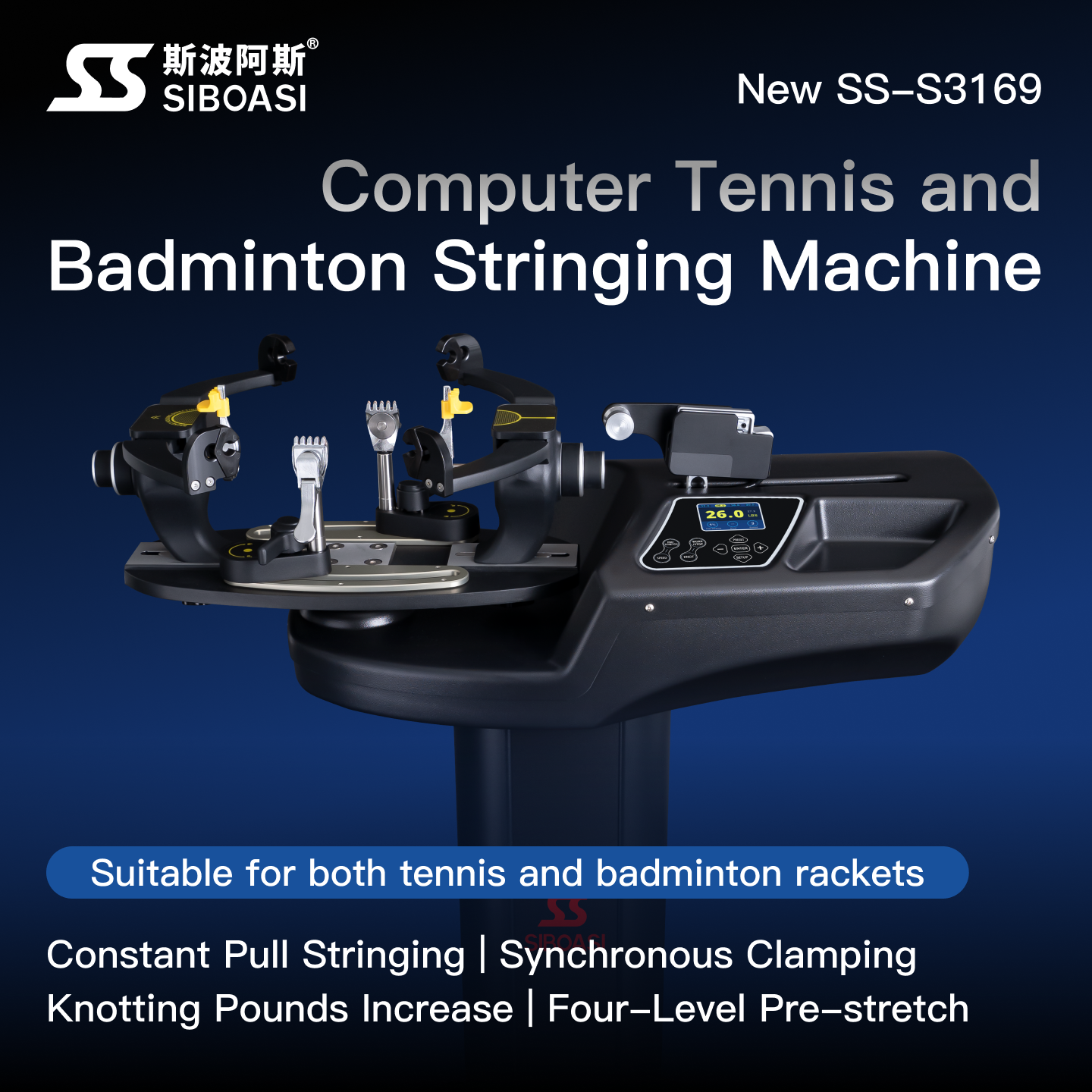
Frame protection remains paramount during stringing operations. A premium badminton racket stringing machine must safeguard delicate graphite structures during every step of the process.
Let us face the strict reality of modern rackets. Under 30 lbs of tension, a fragile frame faces immense compressive stress. The main strings pull the top and bottom severely together. The cross strings pull the sides violently inward. You must control these massive physical forces.
You must strictly use a true 6-point mounting system for commercial operations. This specific setup distributes stress evenly across the entire hoop. It absolutely prevents catastrophic racket breakage. You should avoid 2-point systems entirely for high-tension stringing. Two support points simply cannot stabilize a thin frame under modern tournament tensions.
Best Practice: Always mount the 12 o'clock and 6 o'clock internal supports first. Tighten them just enough to secure the frame without bowing the shaft. Then, carefully engage the side supports.
Clamp quality heavily dictates tension retention across the entire string bed.
Flying clamps attach directly to the strings themselves. They float freely above the racket bed. They are highly prone to slight tension loss when they naturally twist during tensioning. They might suffice for basic budget setups. They remain utterly unacceptable for professional shop standards.
Base-mounted fixed clamps lock directly into the machine's heavy turntable. They hold strings firmly in place without any twisting motion. You should look for gravity-release or auto-locking bases. These advanced features maximize your physical efficiency during long, repetitive stringing sessions.
Ensure all clamp teeth are explicitly designed for this specific sport. They require much finer internal grit and closer jaw spacing. Standard tennis clamps will easily crush or slip on ultra-thin 0.65mm strings. Damaged strings snap prematurely on the court. You will lose customers quickly if you damage their expensive natural gut or thin synthetic strings.
You need a highly structured approach to evaluate prospective equipment. Following a rigorous checklist guarantees you select a highly capable unit.
Micro-Adjustable Tension Heads: The machine must be capable of pulling in minute 0.1 to 0.5 lb increments. Competitive players often request highly specific fractional tensions. Fine-tuning capability firmly separates professional equipment from amateur toys.
Stand vs. Tabletop Configurations: Stand machines offer critical height and tilt adjustments. These essential ergonomic features protect your lower back in high-volume commercial settings. Tabletop models offer necessary portability. They work perfectly for traveling tournament stringers operating out of temporary spaces.
Load Spreaders (High-Tension Protectors): Verify the machine includes solid H-shaped load spreaders. You place these specialized adapters at the 12 o'clock and 6 o'clock frame positions. They distribute focused pressure away from the fragile central grommets. You must source them separately if the manufacturer omits them.
360-Degree Turntable Rotation: Ensure the mounting turntable locks securely. It must rotate smoothly along its primary axis. The racket handle should never clip the tension head during a full rotation. Clearance issues drastically slow down your working speed and frustrate stringers.
Operating professional equipment always involves ongoing maintenance responsibilities. You must anticipate mechanical wear and inevitable calibration issues to maintain peak performance.
All mechanical and electronic tension heads naturally drift over time. You must factor in the vital cost of a high-quality digital tension calibrator. Electronic machines require frequent baseline checks to verify their internal sensor accuracy. Spring-loaded cranks require regular manual recalibration. Internal springs gradually lose their exact tension memory over thousands of pulls.
The highest-wear items are internal clamp springs and heavy base-locking mechanisms. Assess commercial vendor parts availability carefully before buying. Shop revenue halts completely if a proprietary clamp breaks and takes six weeks to ship from overseas. Keep spare high-wear components on hand always.
Best Practice: Clean your clamp teeth weekly with isopropyl alcohol. Invisible string wax builds up inside the teeth over time. This invisible residue causes devastating string slippage and ruins clamping pressure.
Many commercial equipment vendors sell heavy tennis machines disguised cleverly as "universal" machines. Buying a supposedly universal unit requires a rigorous physical audit. You must ensure it explicitly includes sport-specific awls, delicate string movers, and proper interior mounting adapters. Modifying heavy-duty tennis gear for delicate carbon frames often yields terrible structural results.
Final Assessment: The optimal racket stringing equipment balances your exact throughput demands with uncompromising frame protection.
Next Steps: Shortlist two or three reliable commercial vendors.
Evaluate Support: Prioritize manufacturers offering domestic service centers and completely transparent electronic board warranties.
Verify Parts: Ensure they offer readily available replacement clamps and springs.
Demand Proof: Request a detailed technical spec sheet highlighting specific load distribution capabilities before finalizing your purchase.
A: Yes, but only if adapted correctly. You must change the mounting points, install badminton-specific fixed clamps, and use specialized load spreaders. Without these crucial modifications, the heavy tennis equipment will easily crack delicate frames under pressure.
A: High-volume shops should verify tension with an accurate digital calibrator weekly. Independent stringers handling lower volumes should calibrate at least once a month. This routine ensures absolute precision and protects your professional reputation.
A: Constant pull continuously pulls the string to maintain target tension as the internal material stretches. Lockout reaches the initial tension and clamps down immediately. This often results in a softer string bed due to un-pulled string stretch. Constant pull is highly recommended for professional standards.


