


Views: 0 Author: Site Editor Publish Time: 2026-06-24 Origin: Site


Frequent players face escalating repair expenses. They also encounter highly inconsistent tension results. Relying heavily on commercial pro shops creates friction. Shops handle massive equipment volumes daily. This often results in rushed labor. Leaving your gear behind means sacrificing direct control. You lose immediate access to your primary tools.
When string beds lose their snap, your shot accuracy drops dramatically. Securing your own racquet stringing machine solves this dilemma completely. It offers total quality oversight. You gain unmatched scheduling convenience. Players also secure substantial long-term savings over time. You simply need to choose the appropriate hardware tier.
This comprehensive guide bridges a vital knowledge gap. We unpack complex mechanical functionality into simple terms. You will learn how to evaluate various clamping systems. We guide you through matching these setups to your specific stringing volume. By the end, you will confidently select the perfect precision tool.
The fundamental mechanism relies on two independent systems: a mounting apparatus to secure the frame without warping, and a tensioning head to pull strings to an exact weight.
Tensioning systems fall into three categories—drop weight, manual crank, and electronic—each representing a distinct trade-off between price, speed, and tension accuracy.
Mounting systems (2-point vs. 6-point) dictate frame safety; high-end tennis rackets and fragile badminton rackets benefit significantly from 6-point distribution.
ROI on a racket stringing machine typically ranges from 15 to 40 stringing jobs, depending on the machine's initial cost and local pro shop labor rates.
Understanding internal mechanics improves your daily operation. A machine functions through a highly specific dual-action mechanism. First, it immobilizes the racquet completely. Second, it applies linear force to individual strings. These two systems must work flawlessly together. If one fails, the final string bed suffers.
The turntable acts as your foundation. It locks the frame firmly in place. Securing the frame prevents severe structural deformation. Modern tennis rackets endure between 40 and 70 lbs of pressure per string. This cumulative tension easily bends unprotected carbon fiber. A sturdy base absorbs this extreme mechanical stress safely.
Clamps hold the string after pulling. They maintain the tension while you weave the next section. You will encounter two primary clamping configurations.
Fixed Clamps: These attach directly to the machine base rails. They lock firmly into place. Fixed bases offer zero tension loss. They deliver much higher consistency across the entire string bed.
Flying Clamps: These remain completely detached from the base. They secure one string directly to an adjacent string. They cost significantly less to manufacture. However, they remain prone to slight tension bleed during the locking process.
The tension head physically pulls the string. You will process two different string directions. First, you install the mains. These run vertically from the throat to the head. They establish the core structural stability. Next, you install the crosses. These run horizontally across the frame. Crosses require careful over-and-under weaving. Friction increases dramatically during the cross installation. A reliable tension head overcomes this friction evenly.
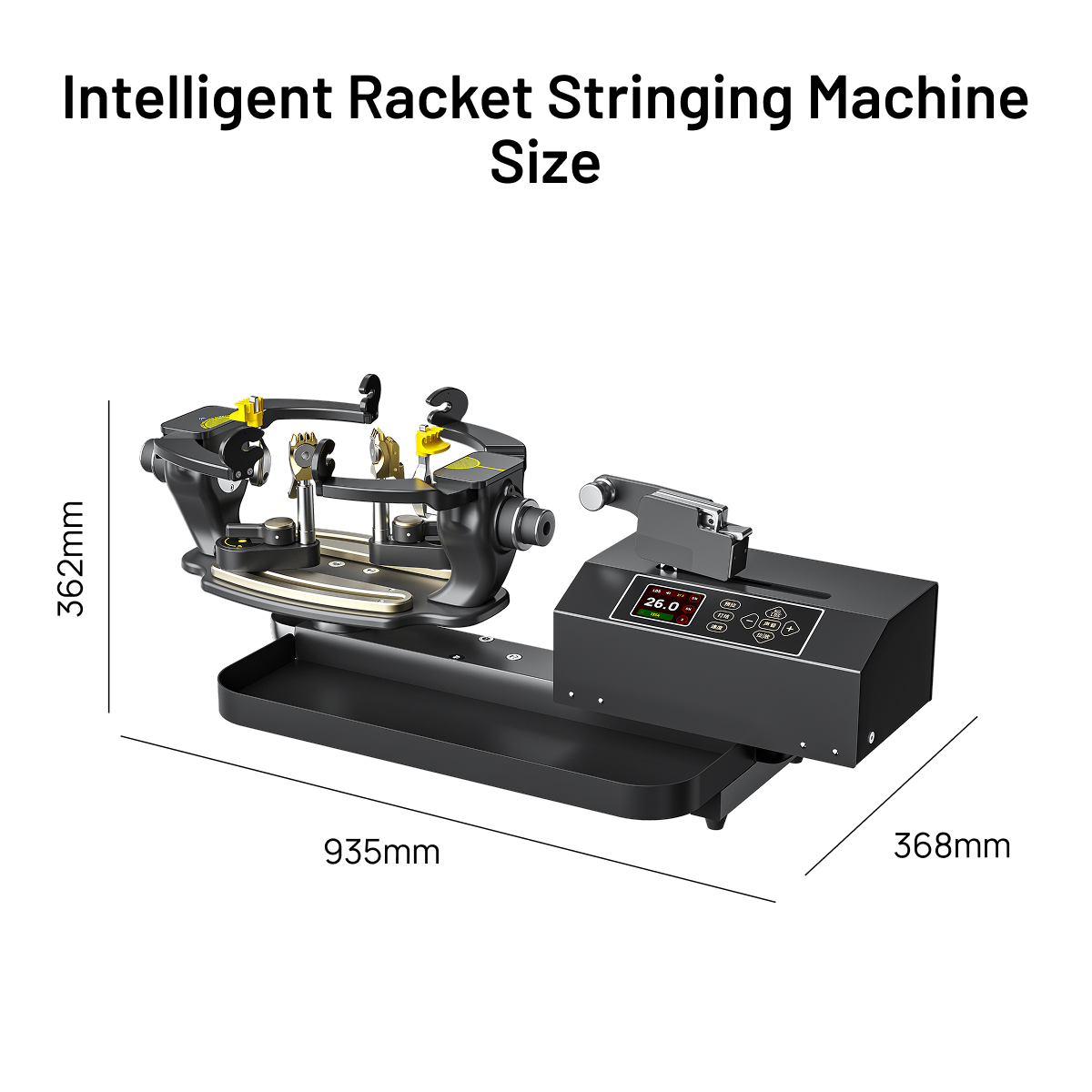
Tension heads define the overall user experience. They dictate both your working speed and your final precision. Manufacturers divide tension mechanisms into three distinct categories. You must align your selection to your personal workflow needs.
Drop weight systems utilize gravity. A sliding weight sits on a long metal rod. You move the weight to your desired tension mark. You drop the arm horizontally to pull the string. Gravity provides a continuous, relentless pull. This creates a true "constant pull" effect.
These machines deliver highly accurate results. However, they operate notoriously slowly. Finding the perfect horizontal balance takes extra seconds per string. They remain the best option for casual players handling personal gear.
Manual cranks utilize an internal spring. You turn a rotary handle to stretch the string. Once the string reaches the target tension, a mechanical brake engages. The system locks permanently in place. This mechanism speeds up your workflow dramatically.
Lockout systems carry one notable drawback. Strings begin stretching immediately after the mechanical lock engages. The machine stops pulling. This results in a slightly lower final dynamic tension. Experienced stringers often increase their target tension slightly to compensate. These systems also require occasional calibration using a digital scale.
Electronic machines dominate commercial spaces. An electric motor handles the physical pulling. A built-in microprocessor monitors the resistance constantly. As the string stretches, the motor micro-adjusts automatically. It maintains the exact target tension indefinitely.
This "constant pull" technology offers unmatched precision. Your working speed increases significantly. Electronic heads require minimal physical effort. They represent the necessary choice for high-volume stringers. Tournament prep operations rely entirely on this technology.
Mechanism Type | Pull Method | Speed | Best Use Case |
|---|---|---|---|
Drop Weight | Gravity (Constant Pull) | Slow | Personal use, casual hobbyists |
Manual Crank | Spring (Lockout) | Moderate | Club players, mid-volume stringing |
Electronic | Motorized (Constant Pull) | Fast | Pro shops, tournament preparation |
Mounting systems dictate frame safety. An improper mount destroys expensive equipment. You must distribute the extreme pulling forces evenly. The industry provides two standard mounting solutions.
A 2-point system secures the racquet exactly at the 12 o'clock and 6 o'clock positions. You clamp the top of the head and the bottom throat area. This setup feels incredibly fast to mount. You clear the sides completely, making string weaving easier.
However, 2-point systems carry distinct structural risks. They concentrate all mounting stress at the top and bottom poles. Rigid, modern frames handle this stress relatively well. Older racquets face a slight risk of inward collapse. Highly customized frames might warp under heavy side tension.
A 6-point system offers maximum security. It secures the frame at the 12 and 6 positions. It also adds four additional diagonal support arms. These arms hug the frame tightly near the corners. The stress distribution becomes entirely uniform.
This system remains crucial for mitigating frame distortion. We highly recommend 6-point mounts for all premium gear. It acts as an absolute mandatory requirement for fragile badminton rackets. Badminton frames utilize incredibly thin carbon walls. A 2-point mount will snap a high-tension badminton frame almost instantly.
Purchasing personal equipment requires upfront capital. You must evaluate the potential return on investment. The math usually favors frequent players heavily.
Commercial shops charge distinct labor fees per frame. You also pay retail markup on the strings themselves. Buying your own wholesale string reels reduces material expenses drastically. You eliminate commercial labor fees completely.
Calculate your break-even horizon using a simple formula. Divide your initial hardware investment by your net savings per job. Your net savings equals the shop restring fee minus your DIY string cost. Most active players hit their break-even point within a single competitive season.
We must acknowledge the hidden cost of personal time. Operating a racket stringing machine requires dedicated labor. A beginner typically takes over an hour per frame. An experienced operator reduces this to thirty minutes.
You must weigh this labor against shop travel time. Driving to a commercial shop takes time. Waiting days for completion drains your patience. Driving back for pickup consumes another afternoon. DIY stringing often saves total hours when factoring in transit.
Financial math ignores massive intangible benefits. You gain instant access to fresh setups the night before a major match. You acquire the ability to experiment freely. You can blend hybrid setups easily. You experience zero wait times during peak tournament seasons.
Owning precision equipment brings a distinct learning curve. You must prepare for minor early frustrations. Proper technique requires focused repetition.
Knot Tying: You must master specific knots. The Parnell knot remains the industry standard. It cinches tightly and prevents tension bleed on outer strings.
Weaving Patterns: Avoiding misweaves on crosses demands intense visual focus. One missed over-under weave compromises the entire string bed.
Clamping Technique: Consistent clamping pressure requires practice. You will inevitably mess up your first few frames. Keep old racquets around for initial practice runs.
Your hardware requires periodic attention. Spring-tension crank machines drift over time. They require regular check-ups using a specialized digital calibrator. You simply measure the pull and adjust the internal spring tension back to baseline. Electronic machines require different care. You must handle the delicate microprocessor components gently. Keep dust away from the linear gripper tracks.
Many buyers remain on the fence regarding electronics. You can scale your setup later. Buyers frequently purchase a sturdy crank system first. Later, they remove the manual crank mechanism entirely. They retrofit a specialized electronic tension head onto the existing base. This modular approach spreads your capital investment over several years.
Determine your commitment level before browsing catalogs. Organize your search by budget tiers. Avoid looking at commercial electronics if you only play twice a month.
Entry-Level Budget: Look at reputable drop-weight models. Accept flying clamps as a reasonable starting point. Focus on sturdy table mounts.
Mid-Range Budget: Target sturdy 6-point lockout crank machines. Ensure the base rail supports fixed clamps. This hits the sweet spot for serious amateurs.
Premium Budget: Evaluate entry-level to mid-tier electronic constant-pull machines. Look for sturdy floor stands and automated linear grippers.
A personal stringing machine represents an upfront capital expense. This investment pays massive dividends in consistency, scheduling convenience, and long-term savings. You remove the middleman completely from your equipment preparation.
Apply realistic purchasing advice. Do not overbuy if you break strings rarely. A basic drop weight handles occasional maintenance beautifully. Conversely, do not underbuy on the mounting system. You must protect delicate badminton frames and high-tension professional gear with proper 6-point support.
Take direct action today. Determine your annual restringing volume accurately. Calculate your local commercial shop fees. Select a machine tier based entirely on the break-even math outlined above. Regain total control over your gear.
A: Yes, but this requires specific hardware adaptations. You need specialized badminton mounting adapters to support the smaller frame shape. Your tension head must also handle accurate low-weight pulls safely. Badminton strings typically require tensions between 18 and 30 lbs, which some heavy-duty tennis heads struggle to measure precisely.
A: Constant pull continually adjusts for string stretch. The mechanism keeps pulling until you secure the clamp, ensuring maximum dynamic tension. Lockout stops permanently once the initial target tension is hit. Because strings relax immediately after stretching, lockout mechanisms result in slightly softer final string beds.
A: Basic competency takes roughly 3 to 5 racquets. During this phase, expect jobs to take over an hour. Building real speed and high consistency takes 15 to 20+ racquets. Once muscle memory develops for weaving and knot tying, you will finish frames in roughly 30 minutes.
A: Fixed clamps are heavily recommended for serious tension maintenance. They anchor directly to the machine base, preventing zero tension bleed. Flying clamps work perfectly well for budget-conscious hobbyists. They clip strings together, allowing slight movement, but they drastically reduce the overall machine manufacturing cost.


