


Views: 0 Author: Site Editor Publish Time: 2026-06-24 Origin: Site


Equipment damage represents a massive frustration for racquet sports enthusiasts. Stringing a delicate badminton frame on a rigid tennis setup often causes disastrous results. You might experience severe frame distortion during the tensioning process. Players frequently report snapped strings or heavily compromised tension accuracy. Conversely, throwing thick tennis polys onto a light-duty badminton mount guarantees immediate slippage and uneven stringbeds.
These mechanical mismatches destroy expensive gear quickly. Using the proper hardware prevents this unnecessary destruction. It ensures optimal playability and extends your racquet's overall lifespan. You genuinely need precise tools matching your specific sport to achieve professional results.
This guide delivers a deep technical evaluation of sport-specific machines versus dual-purpose models. We help you choose the correct equipment effortlessly. You will explore critical tension limits, mounting systems, and specific clamp designs. You will discover exactly which machine perfectly fits your daily stringing volume and primary sport.
Tension & Mechanics: Badminton requires precise micro-adjustments at lower tensions (18–32 lbs), while tennis demands higher limits (40–70 lbs).
Mounting & Protection: Badminton frames are fragile and require specialized 6-point mounting with specific load distributors, whereas tennis frames can tolerate standard 2-point or 4-point systems (though 6-point is still preferred).
Clamp Design: Tooth spacing and coating on clamps must match the string gauge; tennis clamps will crush or slip on ultra-thin badminton strings.
The Best Starting Point: A drop weight stringing machine offers a cost-effective, constant-pull solution that, with the right adapters, can accurately handle both sports without the high cost of electronic models.
Understanding the mechanical divide begins by examining tension limits and calibration accuracy. A dedicated tennis stringing machine prioritizes raw pulling power above all else. It provides immense structural stability under extreme high tension. Tennis players generally request string jobs between 40 and 70 lbs. The heavy-duty tension heads handle thick polyester and rugged Kevlar effortlessly.
A true badminton stringing machine focuses entirely on micro-pound accuracy. Badminton strings operate in a highly sensitive 18 to 32 lbs range. Here lies a major implementation reality for technicians. A heavy-duty tensioner calibrated perfectly for 60 lbs often carries an unacceptable margin of error at 24 lbs. The internal tension spring or electronic load cell simply struggles to detect such low resistance accurately.
Next, consider the respective frame mounting systems. These systems exist to prevent the dreaded warpage risk. Tennis racquets feature thick, robust graphite layups. They handle internal mounting pressure exceptionally well. Many technicians safely use 4-point or even 2-point mounts for standard tennis frames. The hoop integrity easily resists minor uneven pulling forces.
Badminton frames remain incredibly fragile by comparison. They collapse under uneven stress almost instantly. You must use specialized badminton load spreaders. Technicians commonly call these H-blocks. These specific distributors are entirely non-negotiable for safe operation. They prevent 12-o'clock and 6-o'clock frame cave-ins during the tensioning process.
Clamp tooth spacing also dictates your stringing success. You cannot ignore surface texture differences.
Tennis Strings: These strings measure 1.15mm to 1.35mm thick. Tennis clamps feature wider teeth to accommodate this bulk. The smooth inner coating prevents surface scratching.
Badminton Strings: These delicate strings measure 0.61mm to 0.70mm thick. Badminton clamps demand tightly spaced, diamond-dusted teeth. This aggressive texture prevents slippage without crushing the sensitive string core.
We prepared a quick reference table detailing these core mechanical differences.
Feature | Tennis Machines | Badminton Machines |
|---|---|---|
Tension Range | 40 - 70+ lbs | 18 - 32 lbs |
Mounting System | 2, 4, or 6-point (Heavy duty blocks) | Strictly 6-point (Requires H-blocks) |
String Gauge Support | 1.15mm - 1.35mm | 0.61mm - 0.70mm |
Clamp Tooth Spacing | Wide spacing, minimal texture | Narrow spacing, diamond-dusted |
People often wonder if they can simply use one standard machine for everything. Using a tennis machine for badminton introduces massive operational risks. You face a tremendously high likelihood of frame cracking. Standard tennis mounts lack the required surface area to protect thin badminton hoops. The rigid plastic blocks create devastating pressure points on delicate graphite.
Furthermore, wide-toothed tennis clamps consistently fail to hold low tensions. They cause a phenomenon known as "ghost slippage." The string slowly creeps through the clamp teeth unseen. This creates highly inconsistent stringbeds and completely ruins playability. The player receives a loose, dead-feeling racquet.
Workarounds definitely exist for brave stringers. You must modify the hardware carefully.
First, purchase dedicated badminton flying clamps to replace the stock base clamps.
Second, install universal load spreaders at the racquet head and throat.
Third, physically recalibrate the tensioner specifically for the 20-30 lbs range before starting.
Using a badminton machine for tennis presents an opposite, equally dangerous situation. Industry experts generally do not recommend this direction. The mounting towers on delicate machines simply cannot withstand extreme torque. Thick Kevlar and polyester strings exert immense pulling force on the turntable.
Turntable locks on lightweight machines often snap under 60 lbs of pressure. The braking mechanism fails instantly. You risk breaking the machine entirely. The slender mounting arms bend inward under heavy loads. This bends the central rails and ruins the machine's structural alignment.
Manufacturers now build specific combo units to solve this two-sport dilemma. A true double used for tennis and stringing machine originates from a dedicated dual-purpose blueprint. Engineers design it comprehensively from day one. It never treats one particular sport as a mere afterthought.
Key features define a proper combo machine. You must look for easily interchangeable mounting towers. Seek out comprehensive dual-clamp sets included in the box. Some premium brands offer universal clamps featuring specialized adjustable pressure dials. These dials let you tighten the teeth precisely for different gauges.
The tension head must also provide a wide-spectrum sensing range. It should maintain precise calibration from 15 lbs all the way up to 80 lbs. Dual-action load cells handle this effectively. They register micro-tensions accurately while surviving heavy loads. This eliminates the need for constant recalibration between distinct sports.
However, combo machines demand distinct operational trade-offs. Setup time impacts your daily workflow heavily. Switching between sports requires physically swapping adapters, support blocks, and heavy clamps. This easily adds five to ten minutes to your preparation time per frame. High-volume stringers lose valuable efficiency right here.
You also must weigh overall cost versus practical value. These hybrid units cost slightly more than a basic single-sport setup. Yet, they remain far cheaper than purchasing two entirely separate electronic machines. A multi-sport household saves physical space and capital by choosing a high-quality combo model.
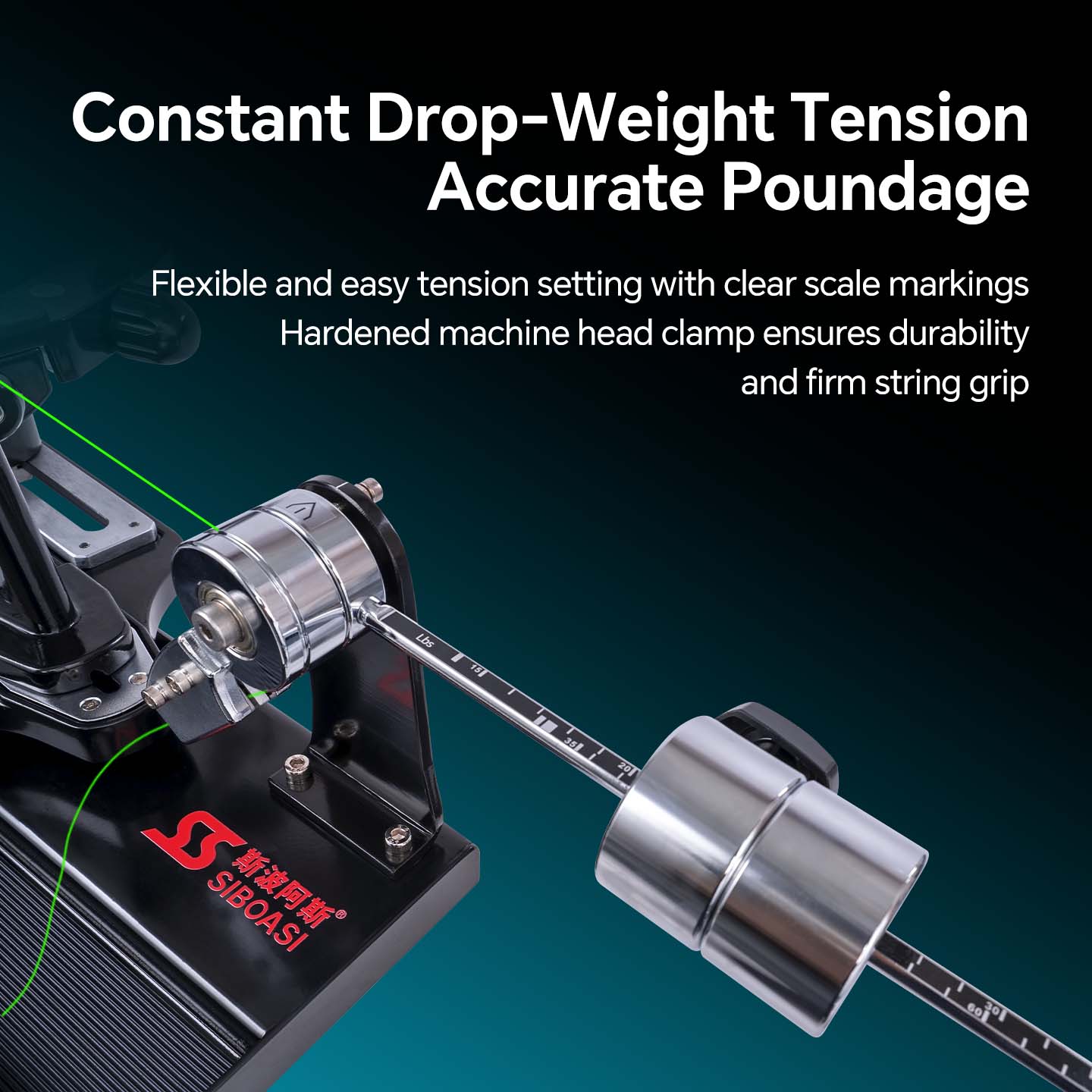
Constant pull superiority sets gravity-based tensioning far apart from basic spring mechanics. A Drop weight stringing machine uses pure gravity to pull the string. This simple mechanism provides a true "constant pull" environment. The weighted arm continues dropping and pulling until the string completely stops stretching.
High-stretch badminton strings require this specific feature to maintain tension. Stiff tennis polys also benefit greatly from constant pull action. Gravity outperforms entry-level crank machines easily. Crank machines simply lock out at a specific distance. They never compensate for ongoing string elongation during the clamping process.
Financial scalability makes these gravity setups highly attractive. They offer the most sensible entry into professional-grade stringing. Small pro shops and dedicated home players appreciate this practical ROI lens. You can comfortably offer dual-sport services without facing a massive upfront investment. Electronic setups often demand thousands of dollars initially.
Gravity models achieve identical tension accuracy for a mere fraction of that investment. You keep your overhead low. You retain the ability to service multiple sports effectively. You only need to purchase the appropriate adapters and clamps once.
Low maintenance adds immense trustworthiness to the gravity platform. You face no fragile digital motherboards waiting to short circuit. You have no internal coil springs slowly losing calibration over time. Electronic machines require frequent servicing and expensive part replacements.
Evidence shows gravity weights maintain pound-for-pound accuracy for decades. Physics never changes. You only need to keep the tension bar perfectly level during the final pull. This ensures the geometric angle applies exactly the requested force. We consider it the most robust tensioning method available today.
Choosing the right equipment depends entirely on your specific daily operational needs. We built a simple decision framework to guide your next investment correctly. Follow these scenario-based recommendations.
For the dedicated tennis player or coach, we recommend a robust single-sport setup. Choose either a lockout crank or a gravity model. Ensure it features standard 6-point mounting. Do not purchase intricate badminton adapters if you exclusively string tennis frames. You will waste money on unused features.
For the badminton specialist, select a highly specialized machine. Look for dedicated inline clamps exclusively. Demand a high-precision, low-tension scaling head. Badminton requires extreme finesse over brute strength. Avoid heavy-duty machines entirely. Focus on mounting security and diamond-dusted clamp quality.
For pro shops and multi-sport families, select a versatile gravity model. Follow a strict checklist before shortlisting your options. Ensure the manufacturer includes both sets of clamps. Verify the package contains dedicated frame supports for both sports. Avoid relying on third-party aftermarket adapters, as they rarely fit the turntable perfectly.
User Profile | Primary Sport Volume | Recommended Machine Type | Crucial Feature to Prioritize |
|---|---|---|---|
Tennis Coach | 100% Tennis | Dedicated Tennis Machine | Heavy-duty 6-point mounting |
Badminton Pro | 100% Badminton | Dedicated Badminton Machine | Diamond-dusted narrow clamps |
Family / Small Shop | Mixed (Tennis & Badminton) | Drop Weight Combo Machine | Interchangeable H-blocks & dual clamps |
Our final verdict highlights the essential mechanical divides between these tools. The main differences lie squarely in clamp precision and mounting pressure distribution. You cannot safely force a thick clamp onto a thin delicate string. You cannot properly mount a fragile frame on a rigid, narrow block. Mechanical compatibility dictates your ultimate success.
We encourage you to audit your actual stringing volume today. Look closely at your past month of activity. Did you string 80% tennis frames and only 20% badminton frames? This honest audit determines whether a dedicated machine or a combo model offers the best practical ROI. Analyze your exact needs. Review recommended machine specifications carefully. Feel free to contact a sales representative for detailed compatibility checks before finalizing your equipment purchase.
A: No. The tooth gaps remain too wide for thin gauges. This leads to severe string bruising or total slippage under tension. You must use badminton-specific flying clamps or completely swap the base clamps before starting.
A: We remain skeptical but balanced on this topic. Universal clamps exist but require constant tension-screw adjustments between sports. You must dial in the pressure perfectly every time. Dedicated sport-specific clamps are inherently safer and faster.
A: Yes. A gravity system typically adds 10 to 15 minutes per frame. You must manually level the weight arm repeatedly. However, it offers far superior constant-pull tension accuracy compared to similarly priced lock-out crank machines.
A: We highly recommend a 6-point mount for modern racquets. It effectively prevents hoop distortion during high-tension pulls. While 2-point systems remain functional for older frames, 6-point systems offer maximum safety. For badminton frames, 6-point mounting is strictly mandatory.


